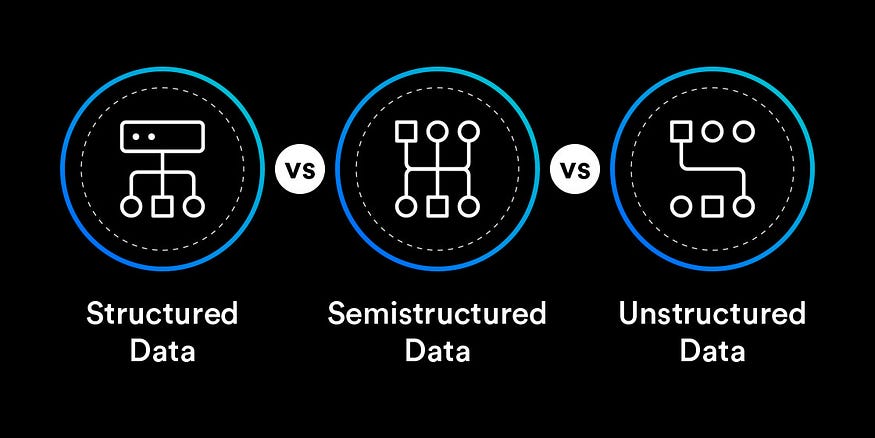

Definition: Structured data is highly organized and formatted in a way that is easily searchable, typically stored in fixed fields within a database. It follows a predefined model or schema.
Characteristics:
Organized in rows and columns.
Conforms to a data model or schema.
Easily searchable, queryable, and analyzable.
Examples include data in relational databases, spreadsheets, and CSV files.

Definition: Semi-structured data does not fit into a rigid schema like structured data but still has some organizational properties. It may contain tags, markers, or a hierarchical structure.
Characteristics:
May lack a formal structure but has some organizational elements.
Can be parsed and processed using tools like XML or JSON parsers.
Examples include XML files, JSON data, log files, and NoSQL databases like MongoDB.

Definition: Unstructured data lacks a predefined format or structure. It is typically raw and not easily searchable or analyzed without specialized tools.
Characteristics:
No predefined structure or format.
Includes text-heavy content like emails, social media posts, videos, images, audio files, etc.
Requires advanced analytics techniques like natural language processing (NLP) or machine learning to derive insights.


0 comments:
Post a Comment
Note: only a member of this blog may post a comment.